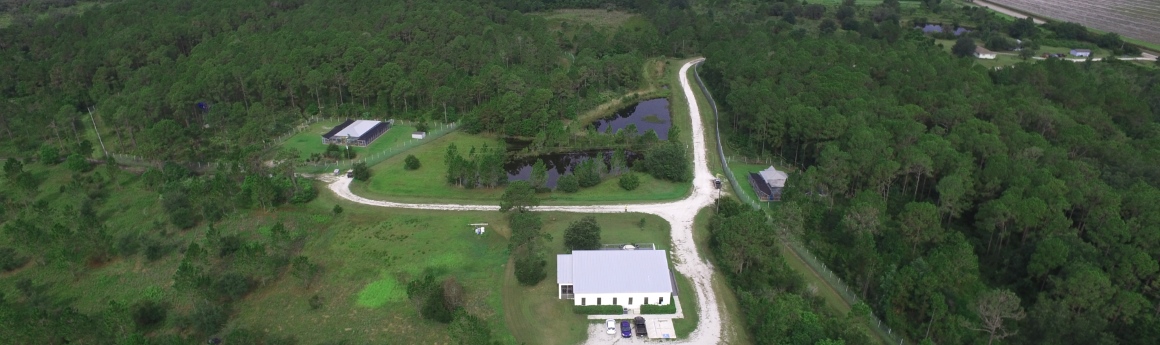
Myakka City Lemur Reserve
The 100 acre Myakka City Lemur Reserve is located in extreme eastern
Manatee County surrounded on all sides by agriculture. A variety of
habitat types occur on the site due to topographical gradients,
various soil types and historical land-uses, allowing environmental
diversity on the reserve. The vegetation zones are defined as
oak-pine mixed forest, upland coniferous forest, live oak hammock,
mixed rangeland, pine flatwoods, scrub and brush land, palmetto
prairie, freshwater marsh, and wetland mixed forest. The lemur
enclosures are located in the forests. Every effort is being made to
maintain the colony in as natural a state as possible so that
behavioral research will be maximally unbiased.
Lemurs on the Reserve
Currently 40 lemurs (7.4 Lemur catta, 1.0 Eulemur
coronatus, 1.1 Eulemur collaris, 7.5 Eulemur
mongoz, 1.0 Eulemur albifrons, 5.0 Varecia rubra, 2.3 Eulemur
sanfordi, 3.1 Eulemur fulvus fulvus) are living on the reserve.
The Foundation works closely with Duke University Lemur Center, Dr. Ian
Tattersall and the rest of the LCF Scientific Advisory Council, the
Association of Zoos and Aquariums (AZA) Prosimian Taxon Advisory
Group, and the Species Survival Plan (SSP) coordinators to ensure
that the colony is maintained and utilized as a prime research and
breeding resource.

Reserve Facilities and Grounds
Two forested 13-acre+ enclosures are surrounded by 13-foot electrified
chain link fences (only the top three feet of the fence are
electrified, and that with low voltage), and the remaining acres
currently serve as a buffer zone for the reserve.
The existing indigenous vegetation has been supplemented by plantings of
mango, passion fruit, guava, grapes, banana, persimmon, and bamboo
species already found to be widespread in Florida.
Within the main forest enclosure, the Reed and
Barbara Toomey Lemur Pavilion, a beautifully designed
cinder-block building divided into eight indoor and outdoor
enclosures, serves to house the lemurs in times of environmental
stress, i.e., hurricanes, electrical storms, controlled fires, the
unusual freezing night, or at any other time the animals should not
be free-ranging. The outside area of chain-link attached to the
building permits the animals to move into the sunlight by day while
remaining confined. Within the air-conditioned and heated shelter is
a food preparation room with a refrigerator/freezer, sink, hot water
heater, examination table and cabinets used for storage.
Around the door of the shelter, New York artist Barbara Sandler has painted
a lovely frieze featuring fruits and flowers that lemurs love to
eat.
Reed and Barbara Toomey Lemur Pavilion
The second 13-acre enclosure of mostly slash pine forest is called
the Jim Toomey Woods, a great
habitat for our lemurs. Within the enclosure is the newest shelter,
the Marilyn K. North Lemur
Lodge. The North Lemur Lodge doubles the amount of room
available for lemurs and includes a separate veterinary room. CF
artist Mary Fussell designed and underwrote an exuberant etched and
sandblasted entrance door to the shelter.
Marilyn
K. North Lemur Lodge in the Jim Toomey Woods
The Michael & Jean Martin
Quarantine Shelter is primarily used for lemurs arriving at
the Reserve. Newcomers must be confined for 30 days to ensure that
they are healthy and disease-free. The shelter has two rooms that can
accommodate two different groups of lemurs.
Michael
& Jean Martin Quarantine Shelter
Outside the forest enclosure there is Fisher
Caretaker's Cottage, which houses the full time
manager/caretaker. There is also a 20' x 40' greenhouse, in which
cold sensitive fruiting plants are grown under organic conditions for
the animals.
The Fisher Caretaker's Cottage
The Researchers' House is
a fully furnished house on site for visiting researchers with 4
bedrooms and 2 baths.
 

The Tranasoa Myakka (Myakka
Welcome House), on 5 acres adjacent to the 100 acre reserve will serve as
staff housing and also accommodate visiting researchers and
professors.

Tranasoa
Myakka
In 2004, a 14-acre palmetto prairie called Red Dog Woods was cleared on the
Reserve and planted with 8000 trees, mostly native oaks and pines. In
15-20 years when the trees mature, it will be fenced to make the 3rd
forested enclosure for additional lemurs.
Red
Dog Woods
br>
br>
The Mianatra Center for Lemur
Studies and the Anne &
Walter Bladstrom Library serve as an on-site educational
resource facility, the centerpiece of the Myakka City Lemur Reserve
campus. The Center supports LCF staff, scientists, researchers,
students and visitors in their efforts to better understand the
nature, ecology and conservation of the primates of Madagascar.
The Center comprises staff offices, a spacious reading/conference
room equipped with the latest audio-visual and computer technology,
and the lemur library made up of virtual, digital and physical
collections about "all things lemur." Essentially, it is a one-stop
globally accessible information resource about lemurs and will serve
as a model for other resources worldwide.
Mianatra
Center for Lemur Studies
br>
br>

 
|